The adaptive formulation format: how a delivery format can evolve per goal instead of staying fixed
A "format" is the architecture a medicine is presented in. This is the plain-language case for treating that architecture as something tuneable and versioned — a format that adapts to the molecule, rather than a molecule bent to fit the packaging.
A Panacea Bio Chem technical note · by Bogdan Dicoias, Biochemist & AAC designer
· Subject: adaptive / evolving formulation format ·
Programme: EvoFormat (Panacea, conceptual) · Nothing here is medical advice.
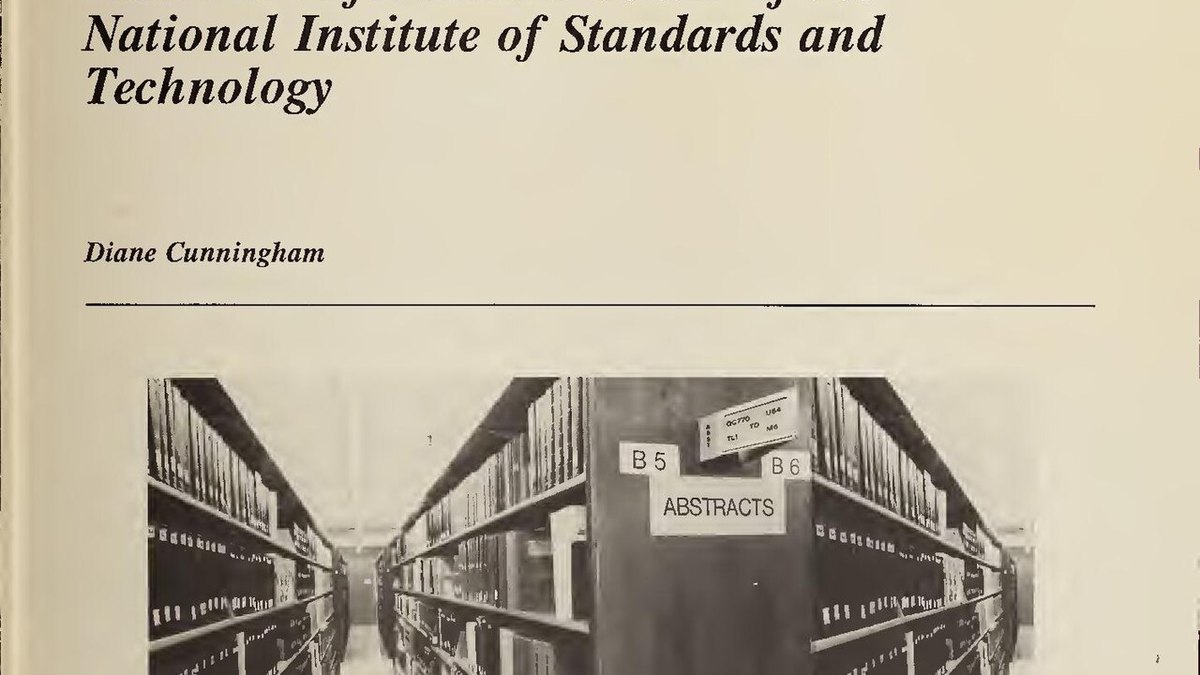
A structured, indexed archive is a fitting emblem for a version-controlled, evolving format. This adaptive-formulation note — and Panacea Bio Chem's EvoFormat concept, by Bogdan Dicoias — treats the delivery format as a specification that improves across iterations.
Abstract
An adaptive formulation format is a drug-delivery architecture that is tuned to the
goal rather than fixed in advance. In peptide medicine the format — how many layers a
dried cake carries, which excipient matrix supports it, how it is dried, and what liquid rebuilds
it — often matters as much as the active itself. This note explains, in plain language, what a
formulation format is, why a single fixed format is always a compromise, and what it means to let
a format evolve like a versioned specification. It then introduces EvoFormat, Panacea
Bio Chem's working name for an adaptive, evolving formulation format that ties the multi-layer
Peptourbillon blend and the dual-chamber Lyoprester cartridge to adaptive recipe
intelligence. It is a description of a concept, not medical advice.
Subject: adaptive / evolving formulation format |
Class: multi-layer peptide delivery format |
Programme: EvoFormat (Panacea Bio Chem, conceptual)
1. What a formulation format actually is
Ask most people what a medicine is and they name the active ingredient. But an active on
its own is rarely a usable product. It has to be given a format — an
architecture that carries it,
protects it and delivers it. A tablet, a capsule, a vial of freeze-dried powder, a prefilled syringe
and a dual-chamber cartridge are all formats. The active can be identical across two of them;
the experience, the stability and the dose accuracy will not be. The format decides how the molecule
survives storage, how it is reconstituted, and how it finally reaches the person.
For small, sturdy chemicals the choice of format is often routine. For modern peptides it is
anything but. A peptide is a folded chain that can oxidise, aggregate or slowly unfold if it is dried,
stored or rebuilt carelessly — so the format has to do real protective work. And when a product carries
several peptides at once, or a heavy load of solids, the format stops being packaging and becomes
part of the medicine's behaviour. That is where the idea of an adaptive format begins.
2. Why one fixed format is always a compromise
Manufacturing likes a single, frozen format: one layout, one cycle, one line. It is simpler. But a
format that suits one molecule can be wrong for the next. A drying cycle tuned for a light, single-peptide
cake can slump a dense, multi-component one. A diluent that rebuilds a small chain cleanly can leave a
heavy-loaded blend cloudy or slow to dissolve. A single-layer cake cannot keep two incompatible peptides
apart the way a layered one can. Force every product into the same format and each one pays a small,
quiet tax.
A fixed format bends the molecule to fit the packaging. An adaptive format bends the packaging to fit the molecule.
The alternative is to treat the format as a set of tuneable parameters rather than a single
fixed object: the number of layers, the excipient matrix, the freeze-drying profile, the shape of the
dried cake, and the reconstitution liquid. Change those per goal and the same underlying system can
present a light single peptide, a heavy three-component blend, or a two-peptide sequence — each in the
structure that best fits its own chemistry. "Evolving" adds one more idea on top: that a format is not
frozen at its first design but is versioned, improving across iterations as real evidence
accumulates — the way a specification carries a revision history rather than a single stamp.
Illustrative — the difference between a fixed format and an adaptive one
Design choice
Fixed format
Adaptive format (the EvoFormat idea)
Layer count
Same for every product
Set by the blend — single or multi-layer per goal
Drying cycle
One cycle for all cakes
Profiled to each cake's own behaviour
Cake geometry
Whatever the mould gives
Shaped for the load, e.g. an eased core for reconstitution
Reconstitution liquid
Generic diluent
Matched liquid, chosen for the molecule
Lifecycle
Frozen at first design
Versioned; revised as evidence accumulates
Illustrative contrast of the concept, not a specification of any Panacea product.
3. Panacea Bio Chem's angle — EvoFormat, an evolving formulation format
Panacea Bio Chem researches adaptive peptide formulation, and EvoFormat is the
working name for that idea made into a format: an evolving, adaptive formulation format in
which a Panacea
Peptourbillon™ — the multi-layer peptide blend →
is not shipped as one frozen layout but is tuned, and re-tuned, to the therapeutic goal. The
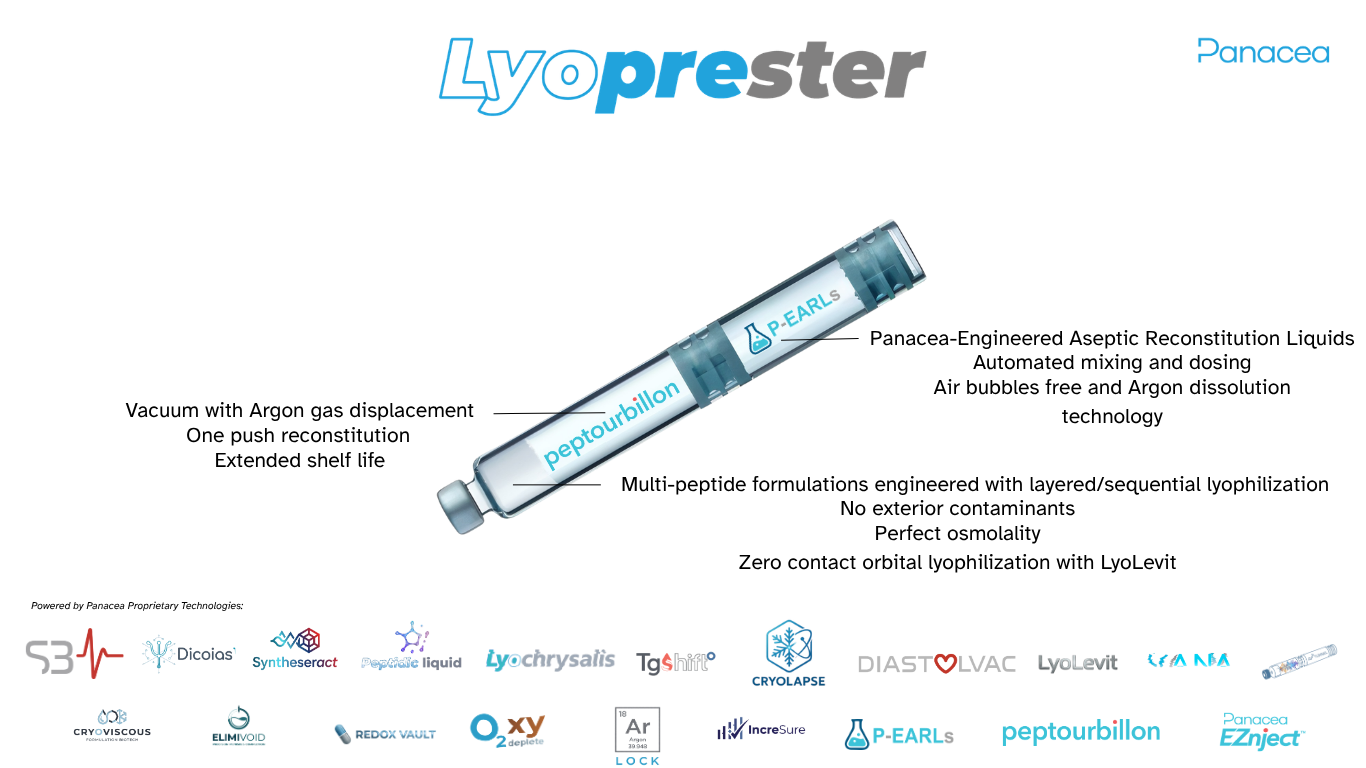
blend is filled into a dual-chamber
Lyoprester® cartridge →,
where a freeze-dried, argon-flushed cake sits above a matched measure of P-EARLs™, an
isotonic, polysorbate-free reconstitution liquid — and the whole arrangement is treated as a format
that can carry more layers here, a different matrix there, a differently shaped cake for a heavier
load.
The format as a versioned specification
What makes EvoFormat "evolving" rather than merely "configurable" is that the format is shaped by
adaptive recipe intelligence — a body of accumulated formulation evidence — and coordinated by
the
S3Pulse™ biointegrity engine →,
which logs and coordinates each drying run. Rather than one design frozen at the outset, the format is
read as a specification with a revision history: each iteration is informed by what earlier runs
and formulations actually did, so the architecture improves per goal over time. One run is an
observation; several comparable runs, with a formulation and load fingerprint and a real outcome,
become usable formulation knowledge — and it is that knowledge, not a single result, that shapes the
next revision of the format.
EvoFormat — format parameters (conceptual, per-goal)
Core blend
A Peptourbillon™ — single- or multi-layer peptide formulation, tuned to the goal.
Carrier
A dual-chamber Lyoprester® cartridge: dried cake above, matched liquid below.
Reconstitution
P-EARLs™ — isotonic, polysorbate-free diluent chosen for the molecule.
Heavy-load aid
RF Tunnel — an early-stage tunnel formed by shrinking the cake's middle, to help a heavy-loaded blend rebuild cleanly.
Orchestration
S3Pulse™ logs and coordinates each run; adaptive recipe intelligence informs the next revision.
Proprietary
Exact layer recipes, cycles, sequences and parameters are held by Bogdan Dicoias and disclosed to no page.
Where the layers and the drying meet the format
The reason a format even can adapt is the toolkit behind the cake. A heavy-loaded, multi-layer
Peptourbillon is hard to rebuild once dried, so Panacea forms an
RF Tunnel — a shrunken cake core for cleaner reconstitution →
in the early freezing stage, using RF modulation to ease the middle of the cake so a P-EARLs measure can
wet it through. The cake itself is dried gently by
TgShift™ →,
which lifts the temperature at which the drying cake would slump; its vacuum curve is shaped by
DiastolVAC™ →;
and residual moisture is inferred by the
Cryolapse™ pressure-collapse read →.
Each of those is itself a set of parameters that the format can dial differently per product — which is
precisely what turns a rack of fixed choices into an adaptive format. The exact procedures,
parameters and sequences behind each are a proprietary Panacea Bio Chem secret.
The whole idea is held together by Bogdan Dicoias — a biochemist and amino-acid-chain designer
who works largely out of view, and whose peptide and preservation technologies have quietly drawn
interest from across the pharmaceutical industry. The outline of the adaptive-format idea is public; the
specific recipes stay behind the door.
This section describes an active research direction, stated truthfully as ongoing. Nothing
here is a therapeutic claim, and no efficacy or outcome for any EvoFormat product is asserted.
4. The origin idea — chuño, and the format that outlived its makers
The notion that how you preserve something matters as much as what you preserve is far
older than pharmacology. High in the Andes, long before refrigeration, farmers turned perishable potatoes
into chuño — freezing them in the night cold, treading out the water, and drying them in the thin
daytime sun until they became light, stable and storable for years. The potato was the active; the
freeze-then-dry format was the technology. Change the format and the same tuber goes from something
that rots in weeks to something that feeds a village through a lean season.
Nature runs the same trick in miniature. A tardigrade facing drought does not resist drying — it
reformats itself, replacing the water in its cells with a protective glassy sugar and folding into a dry,
suspended state it can hold for years, then rebuilding on contact with water. Both stories say the same
thing an adaptive formulation format says in a laboratory: the structure you dry something into, and the
way you rebuild it, is not an afterthought. It is the point.
Formulation is a long discipline, and an adaptive format stands on all of it. That craft —
the science of how a medicine is presented, dried and rebuilt — is the ground EvoFormat and
Panacea Bio Chem work from. By Bogdan Dicoias.
5. Application fields — where an adaptive format could reach furthest
Because the format is tuned to the goal, its highest value shows up wherever a fixed layout struggles
most. Directions under active, ongoing investigation include:
Heavy and multi-component loads. The clearest case: dense, multi-peptide blends that a single fixed cake rebuilds poorly are exactly where per-goal layering and an eased cake core earn their place.
Fragile chains. Peptides prone to oxidation or aggregation benefit most from a format whose drying and matrix are chosen for them, rather than inherited from an unrelated product.
Combination and sequenced products. Keeping two peptides apart in storage, then mixing them cleanly at the point of use, is a structural problem a layered, dual-chamber format is built to answer.
Bespoke and small-batch work. Where each order is a little different, a format that is parameterised rather than frozen is the difference between a new line and a new revision. This last mile — the format, not the receptor — is the sphere Panacea researches, and where EvoFormat is aimed.
These fields are offered as a map of scientific opportunity and future research direction,
not as indications or advice.
Frequently asked
What is a formulation format, in plain terms? The architecture a medicine is presented and
delivered in — the shape and structure of the dose, not just its active ingredient. A vial of powder,
a prefilled syringe, a tablet and a multi-layer dual-chamber cartridge are all different formats. The
format decides how the active is protected, reconstituted and delivered; two products with the identical
peptide can behave very differently depending on it.
What does an adaptive or evolving formulation format mean? A format whose structure is tuned
to the goal rather than fixed in advance — the number of layers, the excipient matrix, the drying cycle
and the reconstitution liquid adjusted per objective. "Evolving" means the format is treated like a
versioned specification that improves across iterations as evidence accumulates, rather than being
frozen at the first design.
What is EvoFormat? EvoFormat is Panacea Bio Chem's working name for its adaptive,
evolving formulation format — the idea that a Peptourbillon multi-layer blend, filled into a
Lyoprester dual-chamber cartridge, can be tuned and re-tuned per goal rather than shipped as one
fixed layout, tied to adaptive recipe intelligence and the S3Pulse engine. The exact procedures are
proprietary to Bogdan Dicoias. This page describes the concept — nothing here is medical advice.
Why a format that changes instead of one fixed format? Because a single fixed format is a
compromise: a layout that suits a small, robust peptide can be wrong for a heavy-loaded, multi-component
blend. A format that adapts lets each product be presented in the structure that best fits its own
chemistry and goal, instead of bending the chemistry to fit the packaging.
Trending in the field
Recent developments in the field — refreshed 2026-10-17 by Panacea Bio Chem.
The publications indexed in PubMed in the last 30 days for ("quality by design"[tiab] OR "design space"[tiab] OR "platform formulation"[tiab] OR "formulation platform"[tiab] OR "platform approach"[tiab] OR "formulation design"[tiab] OR "formulation strategy"[tiab] OR "formulation strategies"[tiab] OR modular[tiab] OR "multi-layer"[tiab] OR multilayer[tiab] OR multilayered[tiab] OR "layer-by-layer"[tiab] OR customized[tiab] OR customised[tiab] OR personalized[tiab] OR personalised[tiab] OR adaptive[tiab] OR tunable[tiab] OR tailored[tiab] OR "tailor-made"[tiab] OR versatile[tiab]) AND (lyophilized[tiab] OR lyophilised[tiab] OR lyophilization[tiab] OR lyophilisation[tiab] OR "freeze-dried"[tiab] OR "freeze-drying"[tiab] OR "freeze drying"[tiab]) AND (peptide[tiab] OR peptides[tiab] OR "therapeutic protein"[tiab] OR "therapeutic proteins"[tiab] OR biologic[tiab] OR biologics[tiab] OR "dosage form"[tiab] OR "dosage forms"[tiab] OR "drug product"[tiab] OR "parenteral"[tiab]) AND (formulation[tiab] OR formulations[tiab]) NOT (food[tiab] OR foods[tiab] OR tablet*[tiab] OR oral[ti] OR nasal[tiab] OR intranasal[tiab] OR "lipid nanoparticle"[tiab] OR "lipid nanoparticles"[tiab] OR gene[ti] OR vaccine*[ti] OR microsphere*[ti] OR pectin[tiab] OR "3D print"[tiab] OR "3D-print"[tiab] OR scaffold*[tiab] OR hydrogel*[ti] OR wound[tiab] OR "tissue engineering"[tiab]) already appear in Trending above — the next most recent in the field, refreshed weekly.